Handkerchief with initial H
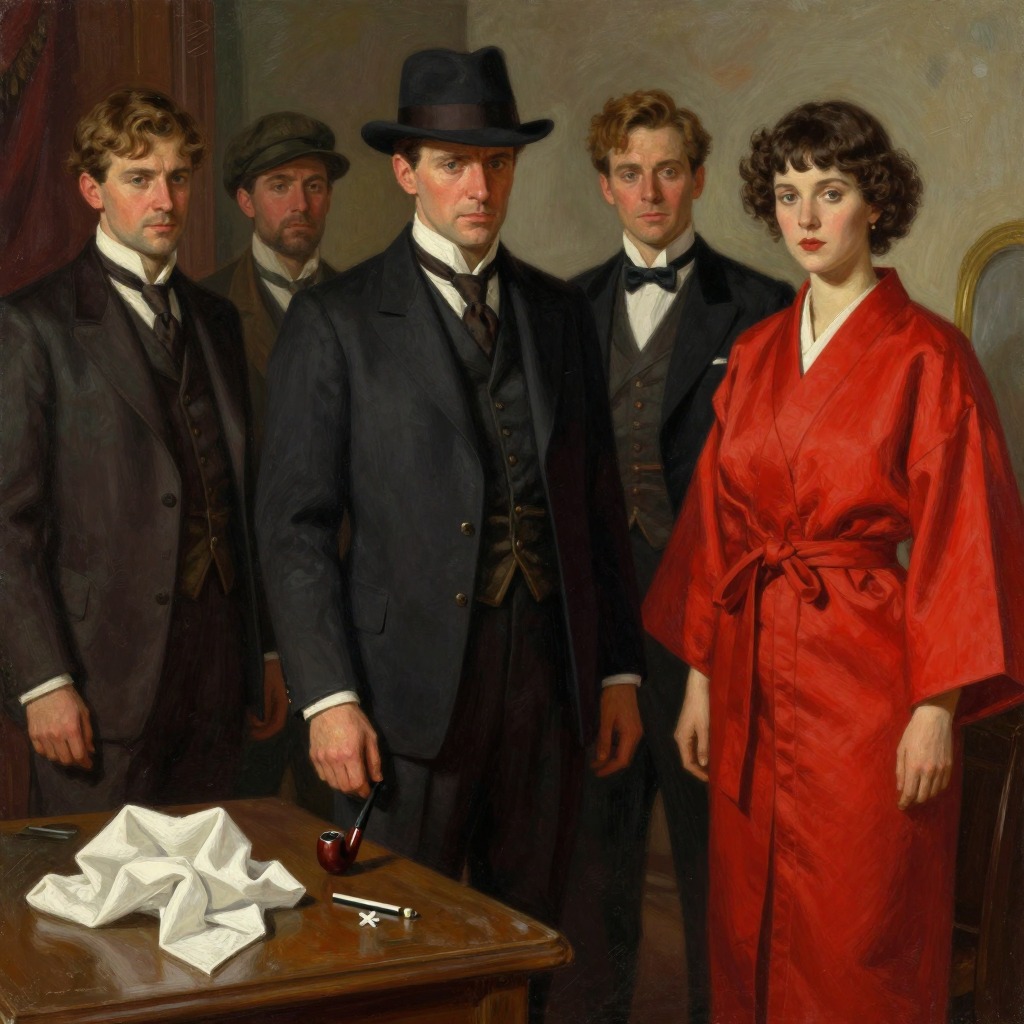
The handkerchief with the initial H is one of the most deliberately misleading clues in the murder of Samuel Edward Ratchett. Discovered by Hercule Poirot on the floor of the victim's compartment, it is a small square of fine cambric, very dainty, with an embroidered initial H in the corner. Its presence at the crime scene immediately suggests a female culprit, and the chef de train had already declared that only a woman would stab so many times. Yet Poirot, ever skeptical of convenient evidence, immediately suspects that the handkerchief may have been planted, noting that it appears "most conveniently" and "exactly as it happens in the books and on the films."
Discovery and Initial Suspicions
Poirot finds the handkerchief while examining the body and the compartment. He picks it up from the floor with a little exclamation, and Dr. Constantine, present at the scene, remarks, "A woman's handkerchief. Our friend the chef de train was right. There is a woman concerned in this." Poirot, however, is not convinced. He points out the implausibility of such a clear clue being left behind, especially one marked with an initial, and muses that it could have been dropped deliberately by a male murderer to frame a woman, or by a female murderer to misdirect suspicion. The handkerchief is thus immediately established as a potential red herring.
The Handkerchief and the Passengers
Poirot tests the handkerchief against several female passengers. Mrs. Hubbard, when shown the handkerchief, denies it is hers, noting that her own handkerchiefs are marked "C.M.H." and are sensible, not expensive Parisian fallals. Miss Mary Debenham, when asked about it, does not claim it. The maid, Hildegarde Schmidt, when shown the handkerchief, hesitates before denying ownership, a nuance Poirot catches. He later uses this hesitation to build his case, realizing that Schmidt recognized it as belonging to her mistress, Princess Dragomiroff, but was uncertain whether to admit it. The handkerchief's initial H is associated with three people: Mrs. Hubbard (Caroline Martha Hubbard), Miss Debenham (Mary Hermione Debenham), and Hildegarde Schmidt. However, Poirot notes that the handkerchief is an expensive, hand-made, Parisian objet de luxe, unlikely to belong to any of these three, but far more likely to belong to a woman of wealth and status, such as Princess Dragomiroff or Countess Andrenyi.
The Revelation of Ownership
The mystery of the handkerchief is resolved when Princess Dragomiroff herself comes to the dining-car and claims it. She states, "I believe, Monsieur, that you have a handkerchief of mine," and when Poirot produces it, she confirms, "That is it. It has my initial in the corner." When M. Bouc points out that her Christian name is Natalia, not beginning with H, she explains with a cold stare, "That is correct, Monsieur. My handkerchiefs are always initialled in the Russian characters. H is N in Russian." This revelation explains why the maid hesitated: she knew the handkerchief was her mistress's but was unsure whether to reveal it. The Princess admits she deliberately lied earlier about not knowing the younger sister of Mrs. Armstrong, stating, "I believe, Messieurs, in loyalty—to one's friends and one's family and one's caste." Her claim is easily verifiable, as she gives the address of the Parisian makers who can confirm the handkerchief was made to her order over a year ago.
Significance in the Investigation
The handkerchief serves as a crucial piece of the puzzle that Poirot uses to unravel the conspiracy. Its presence in Ratchett's compartment, combined with the pipe-cleaner, forms a pair of "clues" that Poirot recognizes as too convenient. He later explains that the conspirators dropped these clues to confuse the issue: the pipe-cleaner to incriminate Colonel Arbuthnot, who had the strongest alibi, and the handkerchief to incriminate Princess Dragomiroff, who was in an unassailable position due to her social standing, frail physique, and alibi. The handkerchief, therefore, is not a genuine oversight but a calculated piece of misdirection, part of the elaborate plan to make the crime appear to be the work of an outside assassin. Its true ownership, once revealed, does not implicate the Princess in the murder but rather demonstrates the lengths to which the conspirators went to protect themselves and the intricate web of loyalty and deception that surrounded the crime.